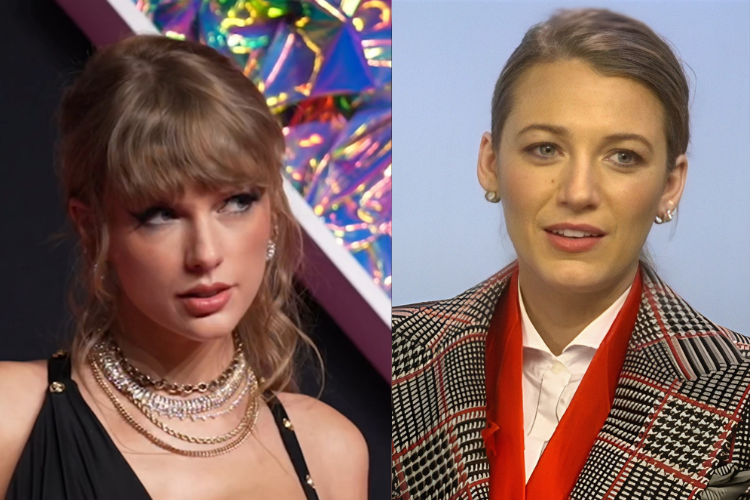
Imagine two of the most recognizable women in modern pop culture, women whose friendship once seemed effortless, supportive, and even aspirational to fans around the world. For years, Blake Lively and Taylor Swift were seen as inseparable, appearing together at private parties, family gatherings, and high-profile events, projecting an image of loyalty and deep understanding. But behind the polished smiles and public appearances, something far more complicated was unfolding. Private text messages later revealed would offer an intimate and emotionally raw look into how and why their friendship began to fracture long before the public ever noticed.
These messages came to light during a tense period in Blake Lively’s life, just days before a critical legal hearing connected to her ongoing dispute with actor and director Justin Baldoni. Although the texts themselves did not explicitly name the participants, accompanying documents made it clear they were exchanged between Lively and Swift. What emerges from reading them is not celebrity drama designed for headlines, but a deeply human story about emotional exhaustion, miscommunication, and the quiet pain of feeling disconnected from someone you love.
In one of the earliest messages, Blake Lively reaches out with a tone that is apologetic, vulnerable, and filled with self-doubt. She admits that she has been feeling like a bad friend, describing herself as emotionally overwhelmed and stuck in a cycle of sadness where she spoke almost exclusively about her own struggles for months. She acknowledges that Taylor Swift had been incredibly generous during that time, not only by being present for her, but by offering patience and understanding when Lively felt incapable of being fully present in return.
Lively explains that it was her husband, Ryan Reynolds, who encouraged her to finally ask Swift directly if everything between them was okay. She tells Swift that she always wants the chance to be a better friend if she has done something unintentionally wrong. Aware of how busy and emotionally stretched Swift is, she makes it clear that she does not expect anything more from her than what she is able to give. More than anything, she just wants reassurance that their bond is still intact.
The message feels familiar in a painfully relatable way, like something anyone might send when they sense distance growing in a close relationship but don’t quite know how to address it. It is careful, emotionally loaded, and filled with the fear of saying too much or too little. Lively is clearly trying to hold onto the connection without pushing too hard, hoping honesty might repair what feels like a growing gap.
Taylor Swift’s reply comes more than an hour later, and while it is thoughtful and measured, it confirms that Lively’s instincts were not wrong. Swift tells her that she is not imagining the shift, though she tries to soften the blow by saying it is not a huge issue. She explains that she is exhausted in every area of her life and that over recent months she had felt a subtle change in the way Lively communicated with her.
At the time, Swift was nearing the end of her massive global tour, an experience that demanded everything from her physically, emotionally, and mentally. She acknowledges that the legal situation involving Justin Baldoni has been extremely stressful for Lively and says she understands how consuming something like that can be. She notes that she has been through similar situations herself and knows how easily they can take over a person’s entire world.
But then Swift shifts into the heart of what has been bothering her. She explains that although Lively’s messages have been kind in intention, they have recently felt strangely impersonal. She compares them to mass corporate emails sent out to hundreds of employees rather than texts exchanged between close friends. She admits that it feels awful to criticize how Lively processes trauma, especially knowing those messages are coming from a place of pain.
Despite that hesitation, Swift is honest about what she misses. She says she longs for her funny, dark, normal-speaking friend, the version of Lively who talked to her naturally and openly instead of through carefully constructed explanations. She recognizes that Lively has been feeling attacked from all sides and that this pressure has likely made her feel the need to overexplain herself. Still, she gently reminds her that she does not need to do that with her.
Swift reassures Lively that she does not need to apologize and that she understands why things have felt different. She ends her message with a simple but emotionally loaded request, asking her friend to come back, not as a polished version of herself, but as the person she has always known.
Hours later, Blake Lively responds with striking honesty. She admits that she has become digitally paranoid and that only after Swift pointed it out did she realize she had been texting the way she writes instead of the way she speaks. She says she did not notice the change at first, but now she sees it clearly and understands how it may have felt distant.
Lively explains that she has been over-packaging even the simplest thoughts because she feels deeply misunderstood and no longer trusts her own judgment of herself. She says that what Justin Baldoni allegedly did to her caused a genuine identity crisis, shaking her sense of who she is at a fundamental level.
She then opens up about what hurt her the most during this period. It was not the actions of people she considered enemies, but the silence of people she thought were good, lifelong friends and allies, who quietly disappeared when things became difficult. That realization, she says, left her feeling more alone than she had ever felt before.
Because of that loneliness, Lively believes she may have clung too tightly to the friends who stayed. She explains that her overly careful, formal messages were not meant to create distance, but were a defense mechanism born from fear, insecurity, and the pain of almost losing everyone.
She thanks Swift for staying, apologizes sincerely, and acknowledges the emotional toll the situation has taken not only on herself but on the people around her. She expresses anger toward the person she believes caused her pain, but ultimately brings the conversation back to gratitude and relief that Swift is still there.
The exchange ends on a softer note, with Lively telling Swift how excited she is for her to finally be done with nonstop travel, suitcases, physical exhaustion, and the relentless demands of touring. The entire conversation took place just days before Swift wrapped up her tour, underscoring how emotionally charged and time-sensitive this moment was for both women.
Rather than revealing a dramatic betrayal, these messages paint a far more nuanced picture of a friendship under strain. They show how exhaustion, trauma, and fear can quietly reshape communication, even between people who care deeply about each other. In the end, it is not a story about fame or scandal, but about two people trying to hold onto a connection while carrying more weight than either of them knows how to set down.